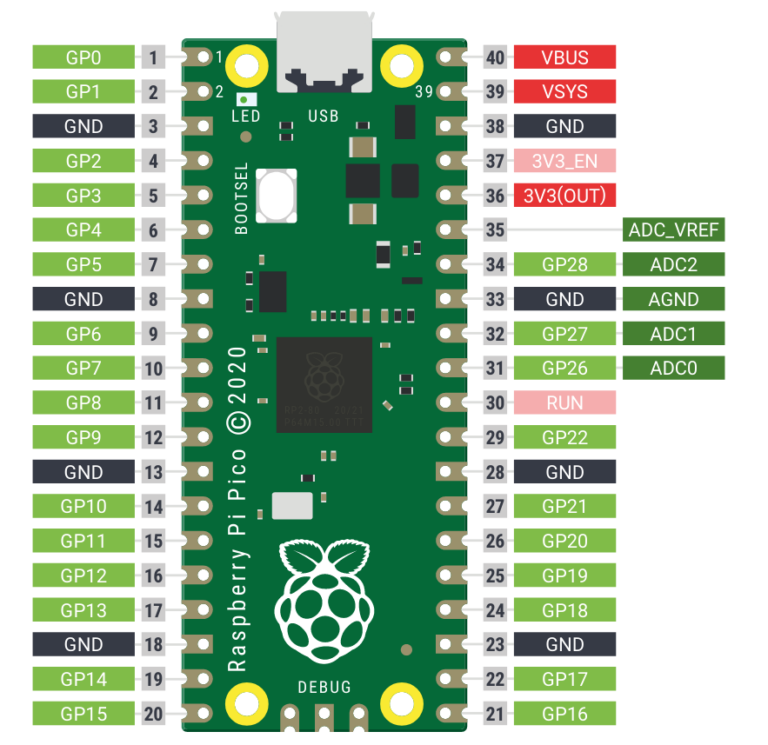
Fig 0.1: Raspberry Pi Pico Pinout Diagram
Preface: The Shop Manual Philosophy
What You Will Learn
Welcome to the garage. This is not your typical programming textbook. If you have ever cracked open a Haynes manual for your car, you already understand the philosophy here: we learn by doing, we learn by analogy, and we learn by getting our hands dirty.
The Raspberry Pi Pico is your engine block. Rust is your precision tooling. Together, we are going to rebuild an embedded system from the ground up, the same way a master mechanic rebuilds an engine: understanding every gasket, every timing mark, every torque specification.
Volume 1: Power & Combustion
GPIO fundamentals, power architecture, clock systems. You will learn to blink LEDs, understand pin physics, and configure the PLL like tuning a turbocharger.
Volume 2: Interrupts & The Crank Sensor
Hardware interrupts, debouncing, rotary encoders. You will master the NVIC, understand contact bounce physics, and build responsive input systems.
Volume 2.1: The Transmission
State machines, Mutex patterns, shared memory. You will design gear logic, implement thread-safe state management, and integrate ISRs with main loops.
Volume 2.2: The Hydraulic Damper
SysTick timers, software debouncing, signal filtering. You will implement time-based logic and build robust, noise-immune input handling.
By the end of this manual, you will not just know how to copy-paste embedded Rust code. You will understand the physics of why GPIO pins need pull-up resistors, the architecture of how interrupts preempt your main loop, and the patterns that professional embedded engineers use to write safe, reliable firmware.
"The goal is not to make you dependent on tutorials. The goal is to make you dangerous with a datasheet."